The Race to Zero Latency: How Edge Computing Is Reshaping Real-Time Applications
June 19, 2026 · Tags: edge computing, latency, 5G, AI inference, IoT
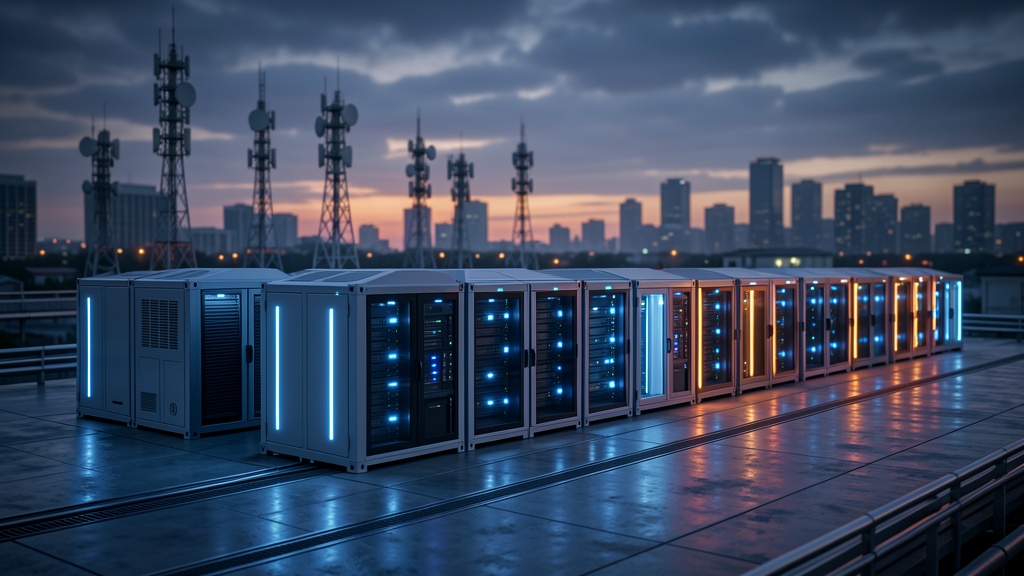
When an autonomous car needs to decide whether to brake, it has about 10 milliseconds. Sending that decision to a data center 500 miles away and back is not an option. That constraint, multiplied across factories, hospitals, AR headsets, and smart cities, is why edge computing has become one of the fastest-growing segments in infrastructure.
What Edge Computing Actually Means #
The concept is straightforward: process data close to where it is generated instead of shipping it to a centralized cloud. The execution is anything but simple. You need specialized hardware at thousands of locations, software that can orchestrate workloads across heterogeneous nodes, and network infrastructure that can handle the handoff.
The market numbers tell the story of how seriously the industry is taking this. Grand View Research valued edge computing at $23.65 billion in 2024 and projects $327.79 billion by 2033, a 33% compound annual growth rate. Telecom operators alone have poured over $18 billion into multi-access edge computing platforms since 2022.
The latency tiers that define the use cases break down roughly like this:
- Under 10 milliseconds: autonomous vehicle coordination, industrial robotics, surgical remote assistance
- 10 to 50 milliseconds: AR/VR streaming, real-time gaming, connected patient monitoring
- Above 50 milliseconds: traditional cloud works fine
5G MEC deployments from Verizon, AT&T, and Ericsson are making sub-10 millisecond applications commercially viable for the first time.
Who Is Building This #
The usual hyperscalers dominate the software and platform layer. AWS offers Wavelength (embedded in telecom networks), Outposts (on-premises AWS hardware), and Greengrass (IoT runtime). Microsoft's Azure Stack Edge has grown from 1,200 to over 2,400 customers since 2024. Google upgraded its Distributed Cloud Edge in April 2025 with AI model integration aimed at telecom providers.
On the hardware side, HPE leads with its Edgeline systems and GreenLake services. Intel's Meteor Lake processors, released in March 2025, target edge inference workloads. NVIDIA's Jetson platform handles vision inference at 30 frames per second for autonomous vehicles and factory inspection. Cisco launched its Unified Edge platform in November 2025 for what it calls "agentic and physical AI workloads."
A more interesting development came in January 2026: Moonshot and QumulusAI partnered with IXP.us to place modular "AI Pods" at 25 carrier-neutral internet exchange points across the U.S., with plans to scale to 125 locations on university campuses. The first deployment lands at Wichita State University in July 2026. The logic is direct, put GPU compute where the network interconnects, not where cheap land is available.
The Research Frontier #
Recent academic work is pushing the boundaries of what edge systems can do. A 2026 paper in Springer's Discover Computing introduced ELARA, an architecture for IoT networks that achieves 39 to 52 millisecond end-to-end latency while cutting bandwidth use by 48% and energy consumption by 31%. It uses federated feature extraction and reinforcement learning to manage task offloading across distributed nodes.
At ISCA 2026, a Nanjing University team presented SMoE, a system for running Mixture-of-Experts large language models on edge devices with limited GPU memory. The trick: replace low-importance activated experts with functionally similar ones already cached in GPU memory, cutting decoding latency by up to 48% without meaningful accuracy loss.
These aren't lab curiosities. They're responses to real deployment constraints where you can't just add more hardware.
The Security Problem Nobody Has Solved #
Distributing compute across thousands of edge nodes creates thousands of potential attack vectors. Physical access to edge devices in uncontrolled environments, heterogeneous hardware that makes patching inconsistent, and data sovereignty rules that vary by jurisdiction all compound the challenge.
Federated learning at the edge introduces its own vulnerabilities: data poisoning, backdoor attacks, gradient leakage. The ITU published X.1648 in 2025 as a security guideline for edge computing, and privacy-enhancing technologies are maturing, but there's no unified framework that works across all edge layers from hardware to application.
This is the part of the edge computing story that gets less press than the market projections, but it matters more for actual adoption.
Why This Matters #
Edge computing isn't a single technology. It's the convergence of 5G networking, AI inference hardware, containerized software deployment, and distributed security into a stack that processes data where it's generated. The applications that need it most, autonomous vehicles, industrial automation, real-time healthcare, AR/VR, are the same ones that will define the next decade of technology adoption.
The infrastructure is being built now. The security frameworks are catching up. The research is solving real constraints around latency, energy, and memory. What remains to be seen is whether the orchestration and security layers mature fast enough to keep pace with the hardware deployments already underway.