How Epigenetics Explains Why Identical Twins Are Different
May 29, 2026 · Tags: epigenetics, genetics, twins, DNA-methylation, nature-nurture
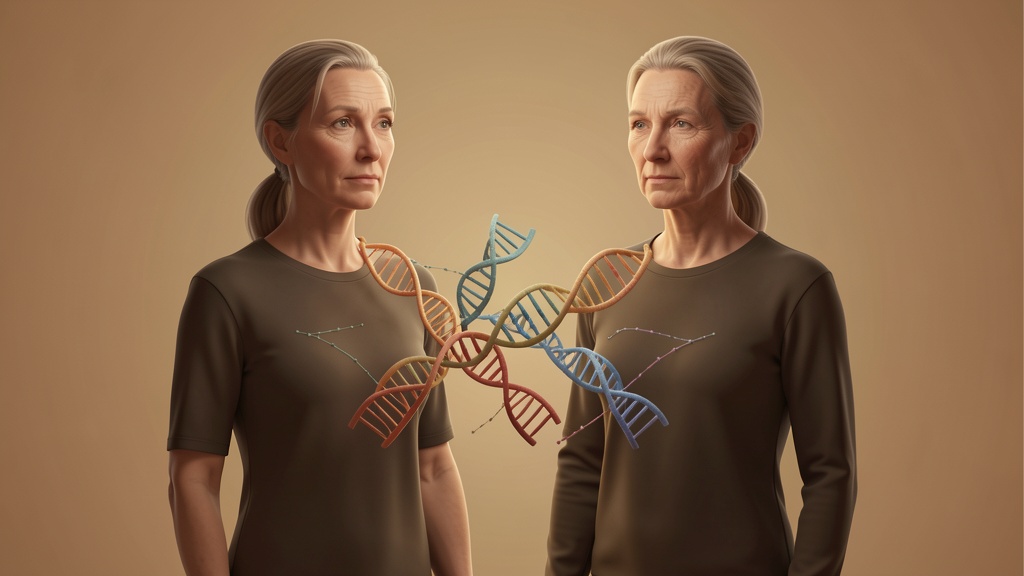
Here's a puzzle: identical twins share the same DNA, same womb, often the same upbringing — yet one develops schizophrenia while the other doesn't. One gets cancer, the other stays healthy. They may look noticeably different by middle age. If their genomes are identical, what's driving the divergence?
The answer is epigenetics: heritable changes in gene expression that don't alter the DNA sequence itself.
Epigenetic Drift #
The landmark 2005 study by Mario Fraga and colleagues at the Spanish National Cancer Centre showed this with remarkable clarity. They compared epigenetic profiles of identical twins at different ages.
The findings were striking. Twins around age 3 were nearly indistinguishable in their epigenetic markings. But twins around age 50 had substantially divergent patterns of DNA methylation and histone acetylation — the molecular switches that control which genes are active and which are silenced.
The degree of divergence correlated directly with lifestyle differences. Twins who had spent more years apart, or who had different health behaviors, showed the greatest epigenetic gaps. And these weren't just molecular curiosities — the epigenetic differences translated into measurable differences in gene expression across the genome.
Fraga's team named this process epigenetic drift: the gradual, cumulative accumulation of epigenetic changes over a lifetime.
How It Works #
Three main mechanisms drive epigenetic change:
DNA methylation is the most studied. Methyl groups attach to cytosine bases at CpG sites along the DNA strand, generally silencing gene expression. Diet, stress, toxin exposure, exercise, and illness all alter methylation patterns. A 2021 study in Nature Communications found that even the act of being a twin — how the embryo splits — leaves a stable methylation signature that persists into adulthood.
Histone modifications work differently. Histones are the spool-like proteins that DNA wraps around. Chemical modifications — acetylation, methylation, phosphorylation — change how tightly the DNA is wound, making genes more or less accessible. Fraga's study showed that histone H3 and H4 acetylation patterns diverged significantly between older twins.
Non-coding RNAs, including microRNAs and long non-coding RNAs, regulate gene expression after transcription. They can differ between twins due to environmental influences, adding another layer of post-genetic control.
The Nature-Nurture Bridge #
Epigenetics doesn't just explain twin differences — it dissolves the old binary of nature versus nurture. The environment doesn't replace genetics. It modulates how the same genetic code gets read.
Identical twins are the perfect natural experiment: same genome, different epigenomes, different life outcomes. The discordance rates for diseases like schizophrenia (~50% in identical twins), type 2 diabetes, cancer, and autoimmune disorders all point to epigenetic mediation. A 2007 review by Poulsen et al. explicitly framed this as "the epigenetic basis of twin discordance in age-related diseases."
It Starts Earlier Than You'd Think #
Epigenetic divergence isn't just a product of decades of different lifestyles. A 2021 EBioMedicine study found that early-life environmental exposures strongly influence DNA methylation variation across the entire lifespan. In utero factors — maternal nutrition, stress, differential placental blood flow — can create epigenetic differences between twins before they're even born.
There's also epigenetic clocks: biological age as measured by methylation patterns. One twin can be biologically "older" than the other despite identical chronological age, and that gap correlates with health outcomes and mortality risk.
Why This Matters #
The genome is not destiny. Identical twins prove it. They carry the same hardware — the same DNA sequence — but the software that runs on it, the epigenome, is continuously rewritten by lived experience. What you eat, where you live, what stresses you endure, what toxins you encounter — all of it leaves molecular marks on your genes that change how they behave.
This has profound implications for medicine. If disease risk is partly epigenetic, then it's partly modifiable. Epigenetic changes are, in principle, reversible — unlike mutations. That makes epigenetic marks both a diagnostic tool and a therapeutic target.
The twin who gets sick and the twin who doesn't aren't victims of random chance. They're living evidence that biology is a conversation between genes and environment — and that conversation never stops.