How Honeybee Colony Collapse Disorder Actually Works
June 24, 2026 · Tags: bees, agriculture, ecology, pesticides
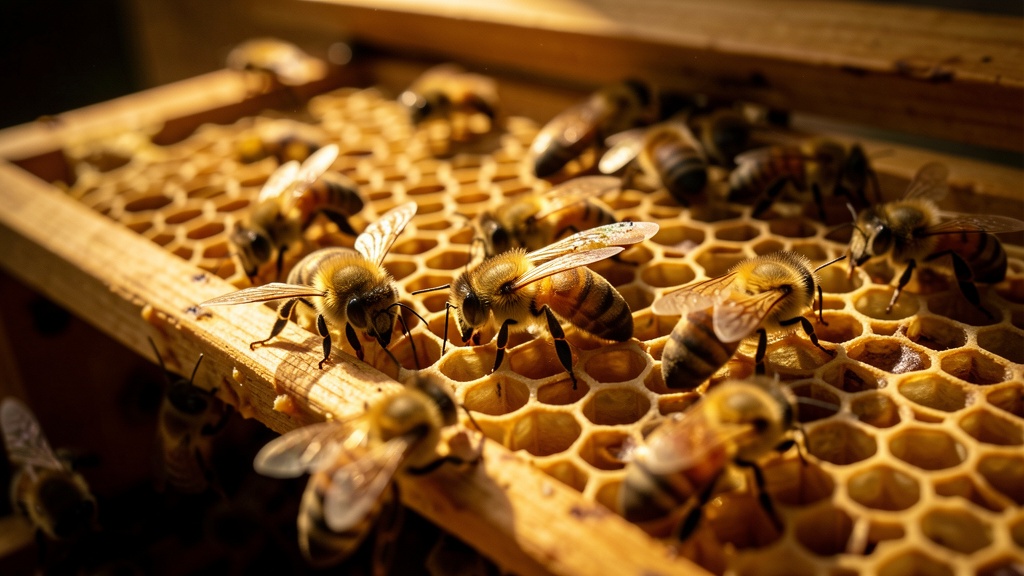
When a honeybee colony collapses, the hive looks almost normal from the outside. Open it up and you'll find a queen, some brood, plenty of honey. What you won't find is the workforce. The adult bees are gone, and they didn't die at home. That eerie emptiness is the hallmark of Colony Collapse Disorder, and it's been devastating beekeepers since 2006.
It starts with a mite #
The Varroa destructor mite is a blood-sucking parasite roughly the size of a pinhead, and it has become the single biggest threat to managed honeybee colonies worldwide. It jumped from the Asian honeybee to the European honeybee sometime in the mid-20th century and spread across the globe through the international bee trade.
The mites do two things that matter. First, they feed on developing bees inside capped brood cells, chewing through the fat body tissue that bees need for immune function and energy storage. Second, and this is the real killer, they carry viruses. Deformed wing virus, acute bee paralysis virus, Israeli acute paralysis virus, Kashmir bee virus. When a Varroa mite feeds on a bee, it injects these viruses like a tiny hypodermic needle.
The virus cascade #
A 2025 USDA study pinned the blame squarely on the virus-mite combination. When commercial beekeepers lost over 60% of their colonies in late 2024 and early 2025, wiping out 1.7 million colonies at an estimated cost of $600 million, USDA researchers in Beltsville, Maryland analyzed the dead bees and found high levels of deformed wing virus A and B, plus acute bee paralysis virus, in every sample.
Here's the mechanism: infected bees die young. When the rate of adult death exceeds the rate at which the queen can replace them, the colony hits a tipping point and collapses fast. The queen gets sick too. A 2025 PNAS study showed that virus infections shrink a queen's ovaries and change her pheromone output, specifically reducing methyl oleate. Workers detect this chemical shift and try to replace the queen, which destabilizes the colony further.
Collapsing colonies don't just die quietly. They become reservoirs, spewing Varroa mites and viruses into nearby hives. In the densely packed operations that pollinate California's almond orchards, one sick colony can infect dozens of neighbors.
Neonicotinoids make everything worse #
Neonicotinoid pesticides, the most widely used insecticides in agriculture, add another layer of damage. These chemicals target the same receptors in bee brains that nicotine hits in human brains. At sublethal doses, they don't kill bees outright. Instead, they scramble navigation, impair memory, and shorten lifespans. Foragers get lost coming home from the field. Waggle dances become less accurate. The whole information-sharing system that makes a colony function starts to degrade.
But the interaction with Varroa is what makes neonicotinoids truly dangerous. A 2019 study in Scientific Reports demonstrated a synergistic effect: bees exposed to both mites and neonicotinoids died at significantly higher rates than bees exposed to either alone. A University of Georgia field study found that colonies feeding on neonicotinoid-contaminated pollen had 5.3 more mites per 24-hour drop count than unexposed colonies. The pesticides suppress bee immunity, making them more vulnerable to the parasites and the viruses those parasites carry.
The resistance crisis #
Beekeepers have been fighting Varroa with synthetic miticides for decades, but the mites are winning the arms race. Coumaphos and tau-fluvalinate, once effective, now face widespread resistance. Amitraz, the last reliable option, is failing too. The 2025 USDA analysis found that 100% of Varroa mites sampled from collapsed colonies carried a genetic marker (a Y215H mutation in the Octbeta2R gene) for amitraz resistance.
Miticide residues persist in beeswax, too. That means chronic low-level exposure even between treatments. A large EU monitoring program found that bees routinely encounter mixtures of multiple miticides simultaneously, since old residues from wax recycling layer on top of new treatments.
Why this matters #
Honeybees pollinate over a third of the food crops humans eat. The 2025 collapse was not a one-off event. It was the predictable result of decades of stacking problems: a parasite that vectors viruses, pesticides that suppress immunity, and a resistance arms race that has stripped beekeepers of their chemical defenses.
The fixes are hard. Breeding Varroa-resistant bee stocks through traits like Varroa Sensitive Hygiene is slow going. RNA interference treatments that could target mites genetically are still in development. Reducing neonicotinoid use runs headlong into agricultural economics. But the basic dynamic is clear: the mites carry the viruses, the viruses kill the bees, and the pesticides keep the bees from fighting back. Until something breaks that cycle, expect more of the same.