The Engineering Challenge of Asteroid Mining
May 18, 2026 · Tags: space, mining, engineering, asteroids
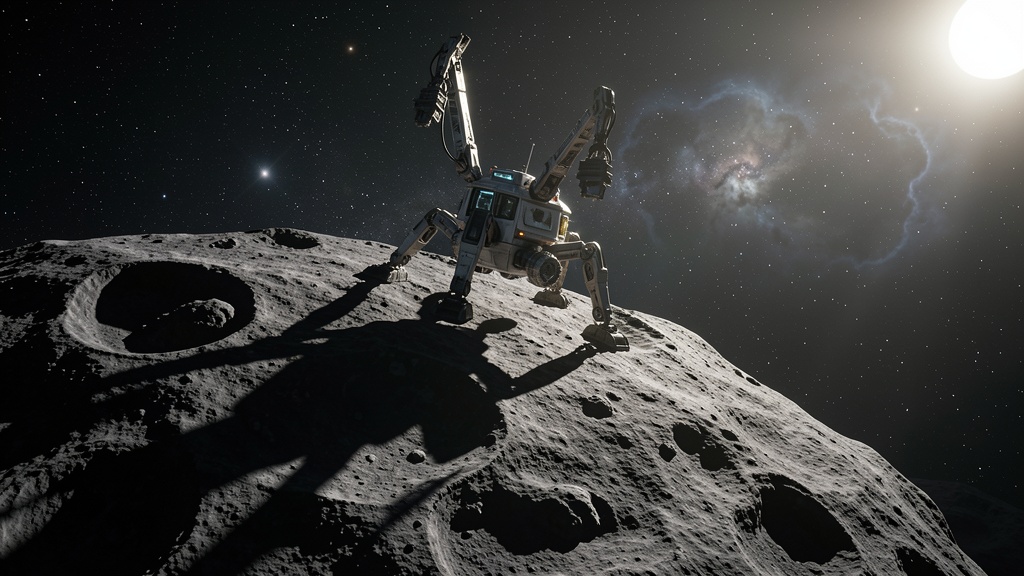
Asteroid mining sounds like science fiction until you look at the numbers. The market was worth roughly $2.5 billion in 2025 and is projected to hit $12 billion by 2035. The broader space economy could reach $1.8 trillion in the same window. But between those projections and actual operations sit a series of engineering problems that most press coverage glosses over entirely.
The Anchoring Problem #
On Earth, mining equipment stays put because gravity holds it down. An asteroid like Bennu has a surface gravity of about 0.0001 g. A drill turning against rock generates a reaction force that pushes the drill bit away from the surface, not into it.
Solutions being tested include harpoons, adhesive pads, nets, and magnetic clamps. The last option is the most promising for metallic asteroids, but every approach assumes the mining equipment already has a grip. The moment before contact is the hardest: approaching a tumbling rock in microgravity with no margin for error.
The Transit Budget #
Reaching a near-Earth asteroid requires a delta-v of roughly 5 to 7 km/s. That is lower than a Mars mission, but a round-trip mining mission with payload return changes the calculus significantly. Ion and electric propulsion get you there efficiently, but the trip takes months or years. Chemical propulsion is faster but burns through fuel that could otherwise be payload.
The tradeoff is not theoretical. Every kilogram of mining equipment you send requires fuel to move it, fuel to return it, and fuel to carry that fuel. The rocket equation is unforgiving.
What We Actually Mine First #
The idea that asteroid mining is about bringing platinum back to Earth is a distraction. Water is the near-term target. Carbonaceous chondrites contain water ice that can be split into hydrogen and oxygen propellant through electrolysis. A fuel depot in orbit, supplied by asteroid water, would reduce launch costs for every subsequent deep-space mission.
Metal extraction requires smelting, refining, and significant infrastructure in an environment with no atmosphere, no grid, and no maintenance crews. Water ISRU is hard. Metal refining on an asteroid is orders of magnitude harder. The timeline difference reflects that: consensus puts water extraction in the 2030s and metal return in the 2040s at the earliest.
The Psyche Data Point #
NASA's Psyche mission, launched in October 2023, will reach the metal-rich asteroid 16 Psyche in August 2029. It is not a mining mission. It carries a multispectral imager, a gamma-ray and neutron spectrometer, a magnetometer, and an X-band radio science instrument. But the compositional data it returns will tell us whether a metallic asteroid actually contains concentrated platinum-group metal deposits or just diffuse nickel-iron with trace elements.
That data will either validate or deflate the economic models driving private investment right now.
Who Is Trying #
AstroForge, named a 2025 World Economic Forum Technology Pioneer, launched the Odin mission to demonstrate asteroid rendezvous and sample return. They claim to have returned approximately 500 kg of platinum-group metals. That claim has circulated widely but remains unconfirmed by independent verification. Karman+ and other startups have raised funding, but no one has demonstrated commercially operational asteroid mining yet.
The gap between demonstration and operation is where most space startups fail.
Why This Matters #
Asteroid mining will not happen because of market demand alone. It will happen when the engineering problems of anchoring, autonomous operation, and in-situ processing become solvable at a cost that undercuts Earth-based launch economics. That threshold is closer for water than for metals, and closer for in-space use than for Earth return. The real story is not about trillions in platinum. It is about whether we can build machines that work on a surface that does not hold them down, with no one nearby to fix them when they break.