You Can Learn to Know You're Dreaming, and Science Is Figuring Out How
June 10, 2026 · Tags: neuroscience, lucid-dreaming, sleep, consciousness
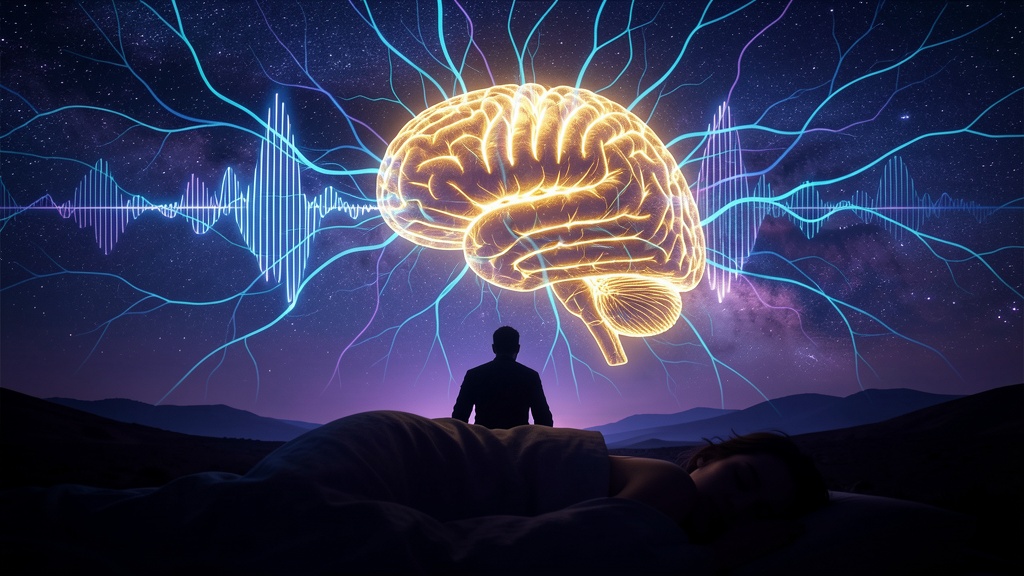
Most people accept whatever happens in a dream without question. You're flying over a city, you're back in high school, your dead cat is alive and talking to you — and none of it seems odd. The prefrontal cortex, the part of your brain that catches logical problems, goes quiet during REM sleep. You're running on narrative autopilot.
But sometimes, mid-dream, something clicks. You realize the hands in front of you have seven fingers. You reread a sign and the words have changed. You notice something impossible and think: I'm dreaming. That recognition, awareness inside a dream, is lucid dreaming. And it's no longer a fringe curiosity. Neuroscientists have mapped its brain signature, developed reliable ways to induce it, and started testing it as a clinical tool.
What the Brain Actually Does #
A lucid dream is not a normal dream with better content. It's a different neurological state. When researchers at Goethe University in Frankfurt used EEG to compare normal REM sleep with lucid REM sleep, they found a sharp spike in gamma-band activity (around 40 Hz) in the dorsolateral prefrontal cortex — the region responsible for self-reflection and executive control. During ordinary dreams, that area is mostly dormant. During lucid dreams, it wakes up.
This is unusual. REM sleep is supposed to suppress prefrontal function. The gamma surge in lucid dreaming looks closer to waking consciousness than to standard dreaming. A 2018 study confirmed the connection from the other direction: people who score higher on metacognitive tests during waking life are more likely to have lucid dreams spontaneously. The trait of self-awareness appears to carry across states.
How to Actually Do It #
Stephen LaBerge at Stanford formalized the science in the 1980s and developed what remains the most validated technique: MILD, the Mnemonic Induction of Lucid Dreams. The protocol is simple. Set an alarm for five hours after falling asleep. Wake up, recall a recent dream, then as you drift off again, repeat an intention: "Next time I'm dreaming, I will remember I'm dreaming." A 2017 study by Denholm Aspy at the University of Adelaide found that MILD produced lucid dreams in roughly 27% of attempts when paired with reality testing.
Reality testing means building a habit of checking whether you're awake throughout the day. Look at text — it shifts and blurs in dreams. Try to push a finger through your palm. Check the time — clocks behave erratically in dream states. The idea is that if you do this often enough while awake, the habit carries into sleep.
The most aggressive approach is electrical stimulation. Voss and colleagues published a study in Nature Neuroscience in 2014 showing that applying 40 Hz transcranial alternating current stimulation during REM sleep induced lucid awareness in a majority of participants. The external signal appeared to activate the same prefrontal gamma pattern that occurs naturally in spontaneous lucid dreams. This was a striking result. It suggested lucidity could be switched on from outside.
What It's Actually Good For #
The most developed clinical application is nightmare treatment, particularly for PTSD. If you can recognize you're dreaming during a nightmare, you can alter the dream in real time — changing the scenario, confronting a threatening figure, or simply waking yourself up. Pilot studies have shown that lucid dreaming therapy reduces nightmare frequency, and the approach is being integrated with imagery rehearsal therapy for combat veterans and trauma survivors.
There's also a motor rehabilitation angle. Mentally rehearsing physical movements during lucid dreams activates motor cortex patterns similar to actual movement. For stroke patients or people recovering from injuries, this could supplement physical therapy — practicing in a dream rather than on a therapy mat. The research is early, but the neuroscience behind it is sound.
The creativity angle gets the most attention in popular culture (Paul McCartney, Salvador Dali, various inventors who claim to have solved problems in their sleep) but it's the least well-studied. Dream incubation (setting a specific intention before sleep) has some empirical support, but the lucid component hasn't been rigorously tested as a creativity tool.
What We Still Don't Know #
A few big questions remain. Are lucid dreams a genuine hybrid state between waking and sleeping, or just brief interruptions of REM? The gamma signature suggests something real, but the boundaries are blurry. Can frequent induction techniques (waking up in the middle of the night, training yourself to disrupt normal dream flow) degrade overall sleep quality? The evidence is thin, but the concern isn't unreasonable. And why some people lucid dream effortlessly while others can't manage it despite months of training is still poorly understood.
Why This Matters #
We spend about six years of our lives dreaming. For most of that time, we're unconscious passengers — narrating, experiencing, forgetting. Lucid dreaming offers a foothold: a way to participate in that experience with some degree of awareness and control. The neuroscience is real, the induction methods work for a meaningful percentage of people, and the therapeutic applications are starting to take shape. It's not magic, and it's not fully understood. But it's a genuine alteration of conscious experience that can be studied, measured, and taught.