The Science of Sleep and Memory Consolidation
June 05, 2026 · Tags: neuroscience, sleep, memory, brain
Your Brain's Nightly Rewiring Session #
Sleep looks passive. It isn't. Every night, your brain runs a sophisticated neural maintenance routine that converts the day's experiences into durable long-term memories. Miss it, and the data simply doesn't save.
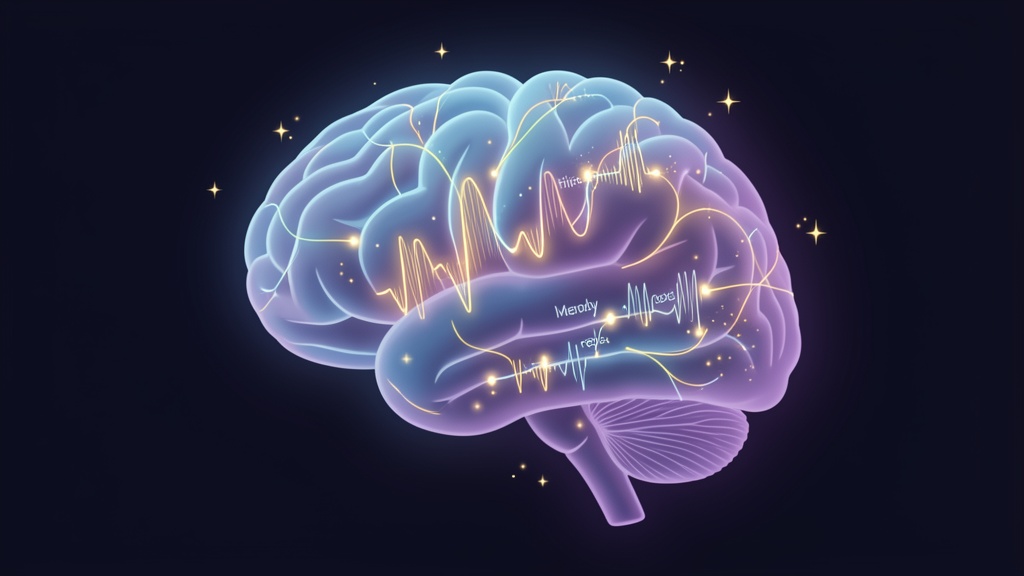
The core of this process is a three-part oscillatory cascade during slow-wave sleep (SWS) — the deep, dreamless phase that dominates the first half of the night. Three neural rhythms coordinate in precise temporal sequence to shuttle memories from the hippocampus, your short-term buffer, to the neocortex, where permanent storage lives.
First, slow oscillations (0.5–1 Hz) sweep across the cortex, alternating between up-states of excitability and down-states of silence. Up-states open windows where the cortex can receive incoming memory traces. Second, the thalamus fires brief bursts of sleep spindles at 11–16 Hz, landing inside those up-state windows and triggering hippocampal reactivation. Third, high-frequency hippocampal ripples (110–180 Hz) nest within the spindle troughs, carrying the actual memory content being transferred.
This slow-oscillation → spindle → ripple cascade is the core dialogue between brain regions during sleep. Disrupt the coupling — through sleep deprivation, alcohol, or noise — and memory retention can drop from roughly 92% to about 60%.
Memory Replay: Fast-Forwarding the Day #
During SWS, hippocampal neurons that fired while you were awake reactivate in the same temporal sequence, but compressed into a fraction of the original time. This high-speed replay strengthens synaptic connections and promotes transfer to the cortex. First demonstrated in rats at MIT in 2003, replay has since been confirmed in humans using intracranial EEG recordings.
The process requires a specific neurochemical environment: low acetylcholine and low cortisol. This low-cholinergic state — unlike wakefulness or REM sleep — permits the hippocampal-to-cortical communication that makes consolidation possible.
The 2024 Reset Discovery #
A landmark 2024 study in Science from Cornell University revealed that sleep does more than consolidate — it resets hippocampal neurons for the next day's learning. During deep sleep, the CA2 region of the hippocampus generates a silencing state that quiets the CA1 and CA3 regions, which had been actively replaying memories. Two parallel circuits of interneurons handle this: one for replay, one for resetting.
This solves a long-standing puzzle. How can the brain learn continuously across a lifetime without exhausting its finite neuronal resources? Each night, sleep frees up the same neurons to encode new information. The therapeutic implications are significant — manipulating consolidation circuits could boost memory in conditions like Alzheimer's, and the reset mechanism opens the possibility of selectively addressing traumatic memory traces in PTSD.
What Erodes This System #
The consequences of disruption are measurable and severe. Blue light exposure and sleep deprivation reduce SO-spindle coupling, impairing both declarative and procedural memory. Aging brings less SWS and more micro-arousals — a 1% reduction in SWS correlates with a 27% increase in dementia risk. Alzheimer's disease reduces spindle amplitude and shortens slow oscillations, accelerating cognitive decline. Even anti-seizure medications can suppress the coupling, dropping memory retention from 92% to 60%.
Enhancing the Process #
Researchers are now testing interventions to strengthen sleep-dependent memory. Closed-loop acoustic stimulation — sounds timed to slow-oscillation peaks during SWS — enhances slow-wave activity and memory in older adults. Transcranial direct current stimulation increases slow-wave activity and improves declarative memory. Targeted Memory Reactivation, which re-presents cues like odors or sounds during SWS, boosts hippocampal activation and consolidation rates. Even pharmacological approaches using cholinergic antagonists can mimic the low-cholinergic state that favors consolidation.
Beyond declarative facts, SWS consolidation extends to motor skill retention and cognitive abstraction. Sleep promotes extraction of hidden rules and patterns, transitioning knowledge from implicit to explicit — the "sleep on it" effect has real neural backing.
Why This Matters #
We spend roughly a third of our lives asleep, and for decades the cultural default has been to treat sleep as negotiable — something to compress when deadlines press or productivity beckons. The neuroscience is now unambiguous: sleep is not recovery from the day, it is the mechanism by which the day becomes learning. Every shortcut taken on sleep is a direct tax on memory, skill acquisition, and cognitive flexibility. Understanding the specific circuits involved doesn't just satisfy academic curiosity — it points toward tangible interventions for aging brains, traumatized minds, and anyone who has ever felt that a good night's sleep made something "click."