Your Blood Pressure Pill Came from a Viper
May 22, 2026 · Tags: medicine, venom, drug-discovery, nature
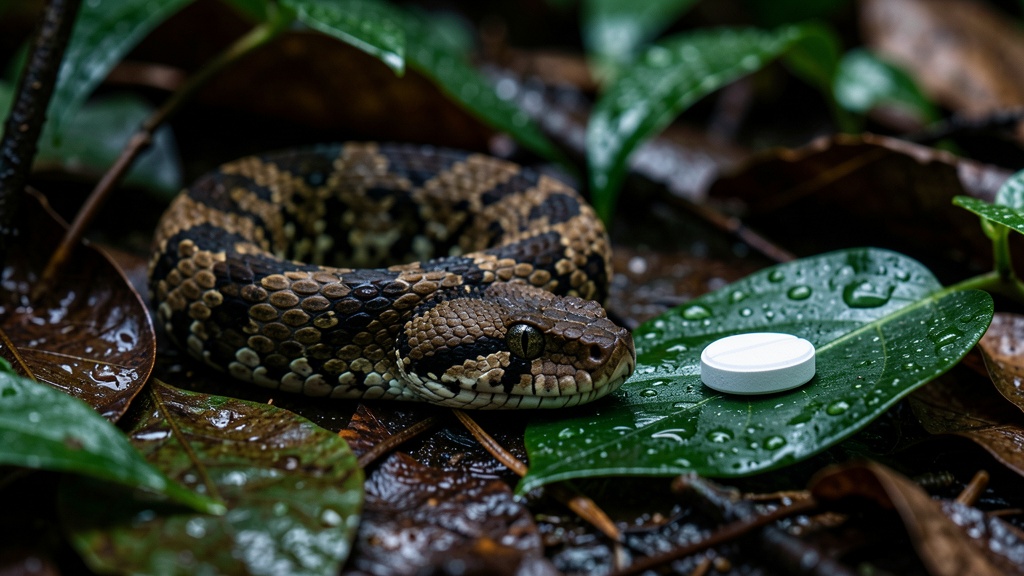
The Brazilian lancehead viper kills. Its venom drops blood pressure so fast that a bite can be fatal within hours. In 1965, a traveler brought one of these snakes to a laboratory in Sao Paulo. Researchers studying the toxin's mechanism noticed something odd: it worked by blocking an enzyme that tightens blood vessels. A decade later, that insight became captopril, the first ACE inhibitor. Today captopril and its derivatives are a $10 billion-a-year market. Roughly fifteen million Americans swallow a pill derived from viper venom every morning.
The Pharmacy You Did Not Know You Were Using #
Venom-derived drugs are already mainstream, not experimental. The FDA has approved eleven of them, with the first arriving in 1981 and the most recent in 2012. Here is the shortlist of the heavy hitters.
Captopril and its descendants. The original, derived from Bothrops jararaca venom. It blocks angiotensin-converting enzyme (ACE), keeping blood vessels open. Hypertension and heart failure are its main targets. Annual revenue across the entire ACE inhibitor class runs into the tens of billions.
Exenatide (Byetta). Based on a toxin in the venomous saliva of the Gila monster, a lizard that eats roughly four meals a year and somehow keeps perfect blood sugar. The molecule mimics a human hormone, triggers insulin release, and slows gastric emptying. It is prescribed for type 2 diabetes and has the side effect of meaningful weight loss.
Ziconotide (Prialt). Synthesized from a cone snail toxin. It blocks N-type calcium channels in spinal cord neurons, cutting off pain signals without any opioid mechanism. It is used for severe chronic pain in patients who no longer respond to morphine. There is no addiction potential.
Eptifibatide and tirofiban. Two antiplatelet drugs inspired by snake disintegrins. They prevent the final step of platelet aggregation, stopping clots from forming during heart attacks and strokes. Cardiologists use them in emergency interventions.
That is four distinct therapeutic areas — blood pressure, diabetes, pain, and thrombosis — all from animals most people try to avoid.
Why Venom Is Perfect Raw Material #
There are an estimated 150,000 venomous animal species on Earth. Venom has evolved independently over 125 times, more often than flight. Each venom is a cocktail of dozens to hundreds of peptides and proteins, refined over hundreds of millions of years to hit specific biological targets with extraordinary precision.
This precision is what drug developers dream of. Most venom toxins are already optimized to bind a single ion channel, receptor, or enzyme. They are potent at nanomolar concentrations. They have been battle-tested in nature. The hard work of molecular engineering is already done.
Snakes alone provide phospholipase A2 enzymes, metalloproteinases, and disintegrins. Cone snails produce conotoxins — disulfide-rich peptides with exquisite specificity for calcium, sodium, and potassium channels. Scorpion venoms modulate the same channels plus acid-sensing ion channels (ASICs), which are implicated in pain. Bee venom contains melittin, a membrane-disrupting peptide with broad antimicrobial effects. Even the humble centipede is in on the act: an elastase-inhibiting peptide from centipede venom has shown promise in reducing pulmonary fibrosis in mouse models.
What Is Coming Next #
The pipeline is opening up. Advances in genomics, proteomics, and AI-powered screening mean researchers can now catalog venom toxins faster than ever.
Tozuleristide, derived from the Israeli deathstalker scorpion, is in Phase 2 clinical trials. It is not a drug in the usual sense; it is a tumor paint. The scorpion peptide chlorotoxin binds specifically to cancer cells. Linked to an infrared dye, it causes tumors to glow green under surgical imaging, letting surgeons distinguish malignant tissue from healthy brain tissue in real time. Pediatric neurosurgeons are already testing it for brain tumors.
In cancer therapy itself, venom-derived toxins are being engineered as precision missiles. Mambalgins from black mamba venom inhibit acid-sensing ion channels and suppress tumor cell growth in leukemia and lung cancer lines. Crotoxin from rattlesnake venom is in a Phase 1 trial for advanced solid tumors. Several labs are attaching venom peptides to gold nanoparticles to deliver cytotoxic cargo directly to cancer cells while sparing healthy tissue.
The antimicrobial angle is equally interesting. As conventional antibiotics lose effectiveness, venom peptides are being investigated against drug-resistant bacteria. Melittin rips bacterial membranes apart in a way they cannot easily adapt to. Several research groups are testing modified melittin variants against MRSA.
Why This Matters #
The irony is hard to miss. Snakebite envenoming kills an estimated 81,000 to 138,000 people worldwide every year, according to the WHO. It leaves another 400,000 with permanent disabilities and amputations. The same substances that cause this devastation are also keeping millions of heart patients alive, millions of diabetics in control, and millions of stroke victims clot-free.
Venom is neither good nor evil. It is a molecular toolset shaped by evolution for predation and defense. Whether it harms or heals depends entirely on which molecule you isolate, which target you aim at, and which dose you use. The pharmaceutical industry spent decades chasing synthetic small molecules it could design from scratch. Most of those efforts failed. The current return to venom-based discovery is not a nostalgic retreat. It is a recognition that nature has already solved problems we are only beginning to understand.
One hundred and fifty thousand species are out there. We have analyzed a fraction of them. The next captopril is almost certainly hiding in a venom gland somewhere, waiting.